


Blue Lock made football feel like a nightclub built inside a penalty box. Every touch is a declaration, every striker has a superpower and every goal arrives with enough ego to bend the floodlights. It is loud, shameless and extremely good at selling the fantasy that one brilliant player can tear a match open.
Aoashi is chasing a different thrill. It wants you to notice the pass before the assist, the run that drags a defender three metres out of shape and the full-back checking his shoulder before the ball has even left a teammate’s boot. Blue Lock asks what creates the decisive striker. Aoashi asks how eleven players learn to see the same pitch.
That distinction matters when Aoashi Season 2 begins on 4 October. The official site confirms a 24-episode season, split into two cours, with Ashito Aoi promoted into Tokyo City Esperion’s A team for the youth Premier League. In other words, the boy who spent Season 1 learning football’s grammar is about to discover that the senior class speaks at twice the speed.
These shows are solving different football problems
The easiest way to compare the two series is also the least interesting: put them in a tournament bracket, declare one “realistic,” call the other ridiculous and let the comments section set itself on fire. But realism is not the dividing line. Both exaggerate. Both turn spatial awareness into drama. Both understand that football is partly a game of forcing somebody else to make a decision they hate.
The philosophical split is in where each show points its camera. The official Blue Lock premise puts 300 young forwards into a survival project designed to produce the world’s greatest egoist striker. Its language is elimination, weapons and individual evolution. The team is the arena in which the self proves its value.
Aoashi starts with an egoist too. Ashito is loud, hungry for goals and convinced he belongs up front. He would not look entirely out of place walking into Jinpachi Ego’s facility. Then coach Tatsuya Fukuda does something far more destabilising than dropping him: he tells Ashito that his future is at left-back.
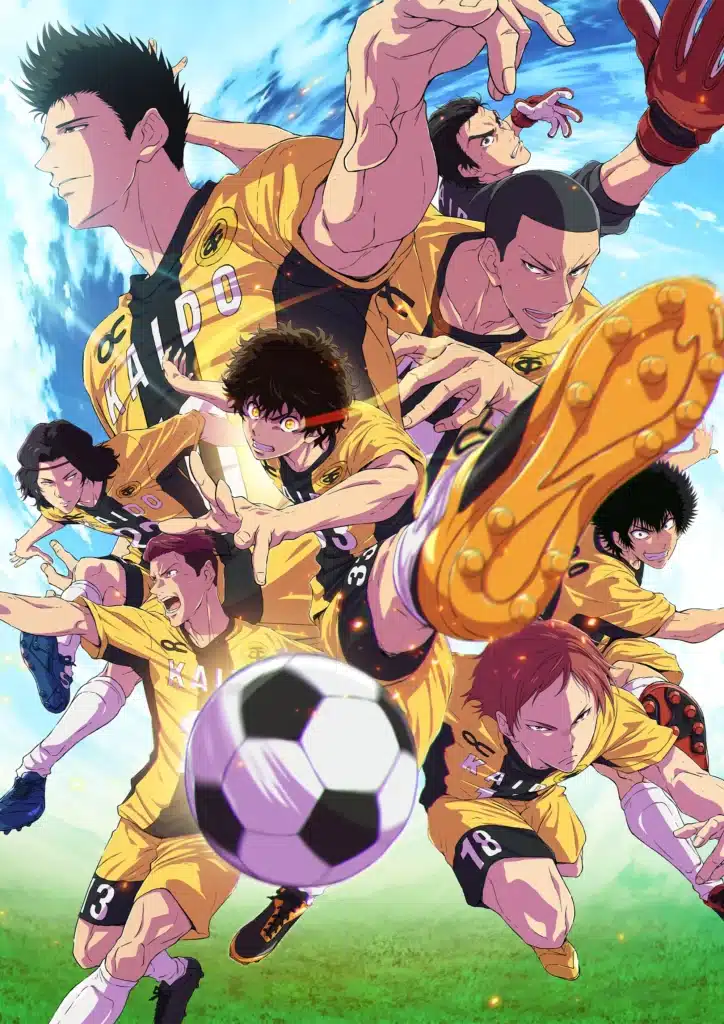
Ashito does not lose his ego. He learns where to put it
That position change is the masterstroke. In a lesser sports story, moving the hero away from goal would feel like a punishment or a detour before his inevitable return to centre stage. Aoashi treats it as a tactical education. Ashito’s gift is not simply scoring. It is his bird’s-eye awareness: the ability to map players, space and movement across the pitch. Full-back gives that vision a larger canvas.
His development is therefore not about becoming less ambitious. It is about understanding that ambition can be expressed through control. An overlapping run can create a shot without producing one. A defender can start an attack by receiving on the correct foot. Holding width for five seconds can be the decision that makes the next three passes possible.
This is why Aoashi lands so hard with football obsessives. It dramatises the actions television cameras often reduce to background motion. The series makes body orientation, scanning, passing lanes and defensive cover feel as consequential as a bicycle kick. It does not merely show you where the ball went. It keeps asking why that route became available.
That same appetite for football detail is why our EA Sports FC 27 hands-on cared less about another glossy animation than whether the match finally felt personal. Spectacle gets you through the door; recognisable football behaviour is what keeps the fantasy alive.
Season 2 removes the training wheels
Esperion’s A team is the perfect escalation because it makes Ashito’s breakthroughs look like basic literacy. The official synopsis says he is overwhelmed by the new level of speed, technique, ideas and physical strength. Players such as Haruhisa Kuribayashi and Keiji Akutsu do not need to wait for him to finish processing the picture. By the time Ashito sees one solution, they are already executing the next.
That is a more frightening obstacle than a bigger striker or a harder shot. At elite level, intelligence is not just seeing the field; it is seeing it early enough to matter. Season 2 can turn every hesitation into pressure. Ashito must scan before receiving, recognise what his teammate recognises and make the correct movement while the opportunity is still real.
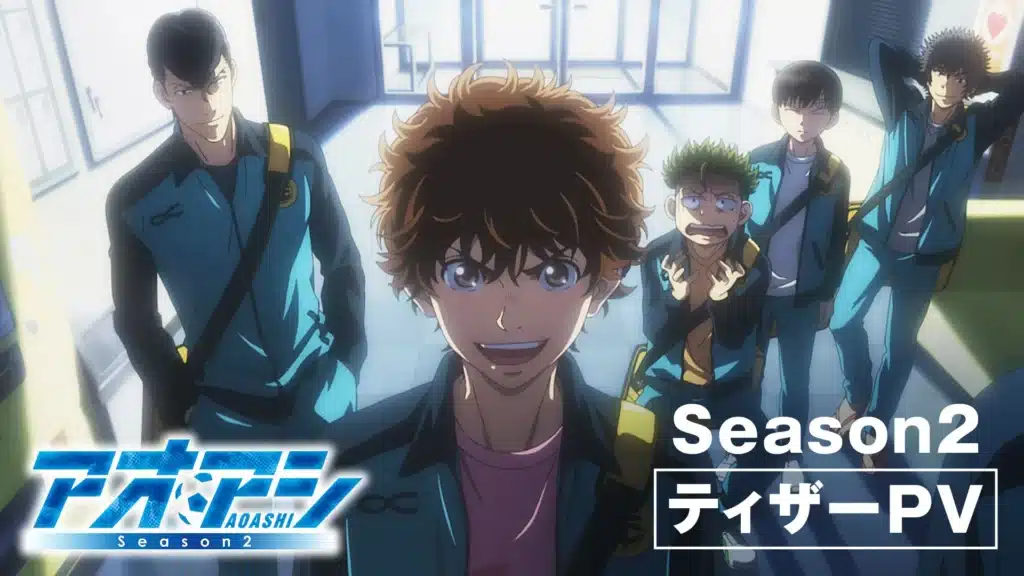
Blue Lock is theatre. Aoashi is a coaching board
None of this makes Blue Lock stupid. Its visual metaphors give invisible competitive ideas a body: a passing option becomes a puzzle piece, a player’s speciality becomes a weapon, spatial calculation becomes something almost supernatural. It makes analysis legible through theatre.
Aoashi makes analysis legible through consequence. A player stands half a metre too narrow and a passing lane disappears. A run begins too late and the defence resets. A teenager misunderstands a coach, repeats the error and has to rebuild his idea of the position. One show externalises football intelligence; the other slows down long enough to teach you how it is assembled.
That is also why comparing their heroes as if only one can survive misses the point. Yoichi Isagi’s story is about weaponising perception in pursuit of the decisive goal. Ashito’s is about turning perception into a shared language. One wants to become the answer. The other has to understand the entire question.
The studio change has one job: keep the pitch readable
Season 2 moves from Production I.G to TMS Entertainment, with Kazuki Yokoyama directing. Series composer Masahiro Yokotani and football supervisor Kenji Iizuka return, while the Crunchyroll spring lineup confirms the Australian stream from 4 October.
The production does not need to make every touch explode. It needs to protect the geography. Wide shots must let us read the distances between players. Cuts must preserve the direction of an attack. The ball, the runner and the defender reacting to both must feel connected. If the audience cannot understand the picture Ashito is seeing, his greatest skill becomes a glowing-eye effect with no meaning behind it.
TMS already has a beautiful A-team key visual and 24 episodes to give this arc room. The test is whether it can make a tactical adjustment feel as urgent as a last-minute goal. Aoashi works when knowledge changes the emotional temperature of a match.
The quiet thrill is the point
Blue Lock made football sexy by turning the striker’s ego into a laser show. Aoashi wants to make the quieter parts irresistible: the shoulder check, the diagonal run, the moment a full-back realises the entire match has been waiting for him to look up.
There is room for both fantasies. But when Ashito reaches Esperion’s A team, Aoashi Season 2 has the chance to do something rarer than produce another spectacular goal. It can teach viewers to recognise the intelligence that made the goal inevitable.
About the author


The conversation
Comments are closed.