

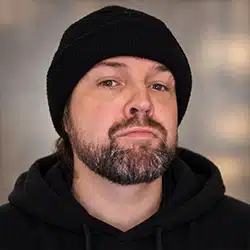
Before Jackbox Games became Toot Games’ publisher, it accidentally helped name the studio. Melbourne animator and comedian Millie Holten used to draw a strange little character called Mr Toot while playing Tee K.O. with designer Matthew Jackson. Years later, the company behind that party game signed their debut title: a stealth comedy about a thief blessed, or perhaps cursed, with one impossibly long arm.
“It felt very kismet,” Holten tells POPTOPIC at PAX Aus.
Holten is Toot Games’ co-founder and art and narrative lead; Jackson is its co-founder and design and technical lead. Together they have spent five years turning a magnificent visual gag into My Arms Are Longer Now, an Australian-made game that plays like Hitman crossed with Untitled Goose Game, only the goose has been replaced by a procedurally generated limb with no respect for personal property.
This interview was conducted at PAX Aus 2026 and has been edited for length and clarity.
Mr Toot began inside a Jackbox game
The studio name predates the studio itself. Five or six years ago, Holten and Jackson were making small game-jam projects together under the name Mr Toot Games. It was never intended to carry the weight of funding announcements, publisher contracts or a booth on the PAX Aus floor.
“I used to draw the same little guy all the time, and I called him Mr Toot,” Holten says. “It’s one of those decisions you make really early on thinking it doesn’t matter because it’s just you two doing a game jam, and then it’s in a press release and you’re like, ‘Oh man, we should have thought about that more.’ But we’re too far in to change.”
The little guy was born during games of Tee K.O., making Jackbox’s eventual involvement wonderfully circular. The publisher’s Australian slate has become increasingly interesting, from this project to its move into physical board games, but Toot’s story feels especially neat: Jackbox helped create Mr Toot, then returned years later to help put the name on a commercial release.

From Long Head to one very long arm
For anyone familiar with Holten’s animation, the game’s elastic bodies, uncomfortable faces and cheerful ugliness are instantly recognisable. Her short Jürgen attracted more than three million views on release, while Long Head has travelled into the tens of millions and earned a 2026 AACTA nomination. Her animation and comedy work has always found warmth inside the grotesque: people bend, stretch and behave terribly, but they remain peculiarly lovable.
My Arms Are Longer Now carries that sensibility into a space the player can physically disturb. Holten’s earlier animations often existed in a liminal nowhere populated by unmistakably Australian voices. The game leans further into place. The Upfield train line appears. The cast is entirely Australian. Even the rhythm of an argument feels local.
“Australian humour travels really well,” Holten says, pointing to the reach of Long Head, Jürgen, Michael Cusack’s work and comedian Sam Campbell. “There is a character who might look a bit like Long Head but legally isn’t.”
That last line arrives with the practiced caution of somebody who knows exactly how quickly an animator’s recurring collection of odd little people can become a shared universe in the audience’s mind.
Five years of development also means the game contains a visible record of its creators improving. Holten says the team has repeatedly reopened early levels because the standard kept moving.
“We’re so much better, we’re so much funnier now,” Holten says. “Let’s fix things.”
It sounds dangerous for a project that must eventually ship, but it also explains why the demo feels authored rather than merely decorated. Animation is not a reward pasted between levels. The poses, interruptions and background performances are the comedy system.
The entire comedy room gets a voice
Holten and Jackson met through improvisational comedy roughly a decade ago, and improv now sits underneath the game’s dialogue. Holten estimates around 75 per cent is scripted and 25 per cent improvised, although the border is deliberately loose.
“We’ll have maybe six lines that are scripted for an interaction,” Holten explains. “Then it’s no bad ideas. Everyone riffs together.”
The result is chatter that feels like people discovering a joke rather than actors dutifully arriving at one. Characters talk over each other, panic in different directions and occasionally pull a scene away from its planned destination. That looseness suits a game whose central verb is creating a problem and then watching strangers attempt to explain it.

There was one unexpected brake on the room: children. Early public demonstrations attracted younger players, so the team decided to keep the finished game within a PG rating. An Australian improv cast occasionally needed reminding.
“Sometimes we had to go back and redo things,” Holten says, laughing. The game can commit what she calls “emotional murder” by destroying a person’s dignity, but actual murder is off the table.
A simple joke became a brutal technical problem
The arm looks simple because the technology beneath it is anything but. The first version was entirely 2D, built from stacked images. Then Holten produced a mock-up in which the limb tangled over and under itself. Jackson had the unenviable job of explaining that the desired effect could not work in the existing system.
The solution was to rebuild the game as 3D while preserving the appearance of a 2D cartoon. Jackson and programmer Cherie Davidson developed a procedurally generated 3D mesh for the arm, then tuned rope-solver physics, layers and shaders until it could cross itself, slide around objects and remain appropriately revolting.
Jackson says the team has “bent and pushed” Unity into doing things it was not naturally eager to do. Only a handful of assets are conventional 3D models; most of Holten’s art is projected or wrapped around deliberately simple geometry.
That hybrid construction is the game’s quiet triumph. The arm feels physical enough to become tangled, trapped and clumsily expressive, while the world retains the handmade timing of Holten’s animation. You do not simply steer towards an item and press steal. You plan a route through railings, furniture, bodies and security, then retract the entire mess without knotting yourself around half a suburb.
The developer’s “Hitman meets Untitled Goose Game” pitch is accurate, but undersells how much of the comedy comes from handling the arm itself. Snake punished you for touching yourself. Toot Games encourages it.
Jackbox signed the weird version
A larger publisher entering a five-year independent production can produce one of two outcomes: stability, or a sanitised version of the thing that attracted attention in the first place. According to Holten, Jackbox chose the former.
“Honestly, complete artistic freedom,” Holten says. “They get it because they’re a game studio.”
The publisher’s notes have largely concerned practical issues such as ratings rather than creative direction. That matters for a game whose identity depends on remaining a little grubby. Its jokes would not survive a committee trying to make the arm aspirational.
Funding from Screen Australia and VicScreen helped the team expand, part of a broader national investment in Australian game development. At its largest, Toot Games involved around 12 contractors. During the less glamorous QA and bug-fixing phase, that number sat closer to five, with Holten expecting it to contract back towards the founders and their producer as the project approached its next stage.

Five years, twelve contractors and one criminal limb
The premise grows stranger beyond the individual heists. A detective who is one day from retirement interviews the arm’s victims and is slowly tormented by the trail of indignities left behind. He gives the chaos a narrative spine while the player continues treating other people’s possessions as a series of invitations.
When I point out that five years is nearly half a Grand Theft Auto VI, Holten offers a more ambitious conversion rate: “Try a quarter.” It is the sort of answer that suits Toot Games—dry, immediate and slightly more dangerous than required.
My Arms Are Longer Now is currently targeting a Q1 2027 release on Steam, according to the studio’s official press kit. The demo will continue changing before then; Holten and Jackson were already preparing another test build when we spoke.
It will arrive in a healthy Australian indie scene—the kind represented by the PAX Aus 2026 Indie Showcase—but there is not much else that looks, sounds or misbehaves quite like this. A viral animator, two improvisers, a rope solver, public funding and the makers of Tee K.O. have somehow converged on the same criminal arm.
Perhaps Mr Toot really was kismet. Or perhaps this is what happens when a joke is allowed to live for five years: it grows an arm, steals your wallet and earns its own press release.
About the author




The conversation
Comments are closed.