


SCSKiller is attracting attention for a promise PC players have wanted for years: get the shader-compilation work out of the way before a game starts throwing punches. The free Windows tool is gathering fresh discussion around games such as Star Wars Jedi: Survivor, and its most useful feature may be its honesty about what it cannot fix.
The project is drawing player reports and developer replies on Reddit, while its 10 October changelog shows another round of fixes. That makes it worth watching. It does not make every enthusiastic before-and-after comparison a promise for your PC.
SCSKiller moves the wait before the game
A shader helps a graphics card draw the effects a game needs. When the necessary graphics pipeline has to be compiled during play, the next frame can wait for that work to finish. A fast machine can still deliver a miserable little pause at exactly the wrong moment.
According to the project’s technical documentation, SCSKiller builds pipelines into the graphics driver’s cache ahead of time. It reads the game’s shipped shaders and works out the combinations it expects the game to request. The game stays closed during compilation.
That is a more interesting proposition than another preset that simply turns everything down. It tries to change when the expensive work happens, rather than asking players to make an expensive game look cheaper. The waiting still exists; the ambition is to move it somewhere less irritating.
For games where the files do not provide enough information, an optional recorder can help fill the gaps during play. The documentation explains that this is separate from the ordinary pre-compilation process. It should not be treated as a universal, invisible switch for every game in a library.
The dramatic numbers need their small print
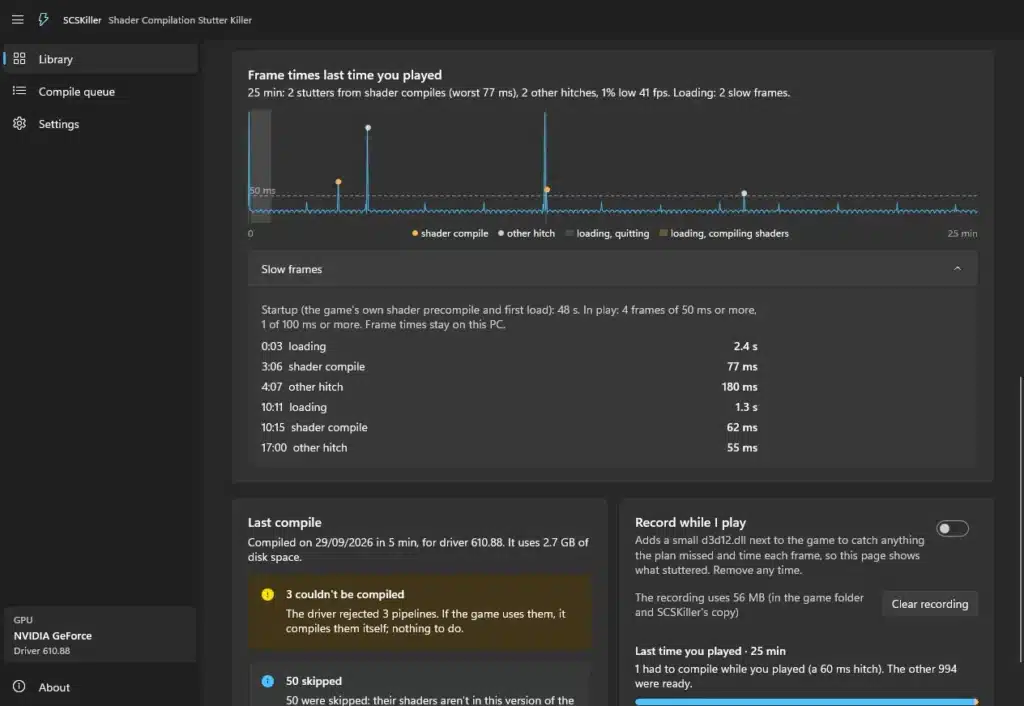
The developer’s published measurements report 9,038 shader-compilation stalls falling to 11 in Star Wars Jedi: Survivor on an RTX 5090. The comparison covers roughly five minutes of play from a cold driver cache, then another run after compilation. These are the developer’s results, not POPTOPIC testing.
Other listed examples include Final Fantasy VII Rebirth going from 19 qualifying stalls to zero and Hogwarts Legacy dropping from 1,014 to 87 on the same GPU. A qualifying stall is a shader compile that holds the game up for at least 20 milliseconds.
Those counts describe one source of hitching. They do not say that an entire game became stutter-free, or that average frame rates improved by the same percentage. Streaming new assets and moving between areas can cause pauses for different reasons. SCSKiller explicitly leaves those problems outside its remit.
That distinction matters as much as the flashy number. As with the early PS5-emulation milestone POPTOPIC covered, a technical result needs its context before it becomes a useful expectation.
A fresh update tackles the rough edges
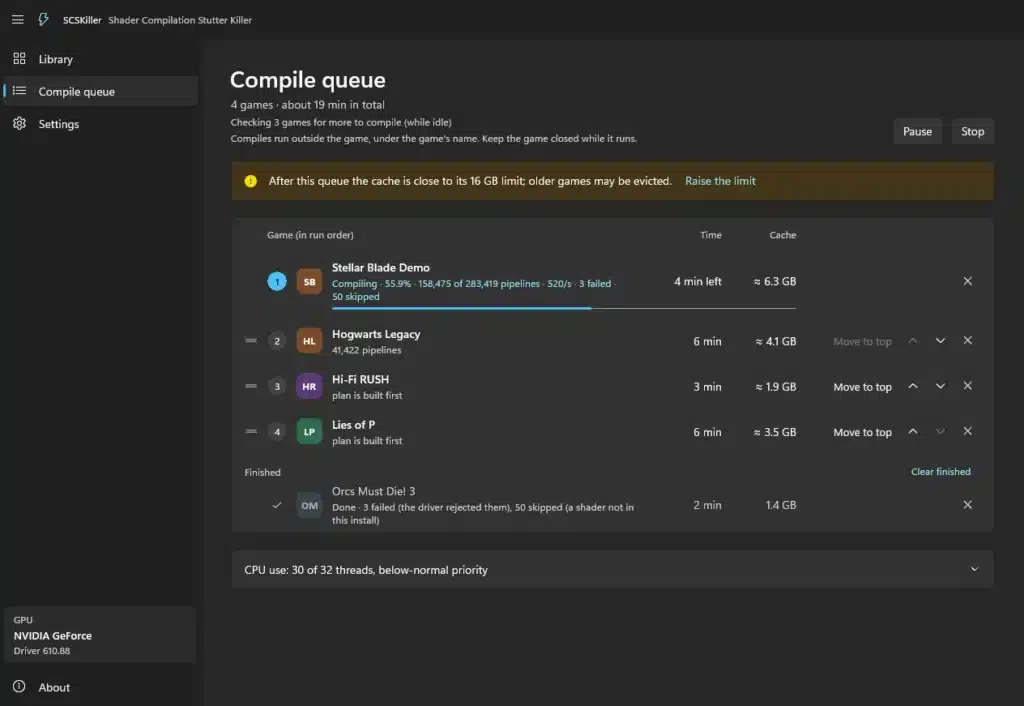
The 1.2.5 changelog, dated 10 October, addresses compilation getting stuck near completion, long chains of ray-tracing pipelines and background work slowing the queue. It also identifies an AMD cache mismatch that could repeatedly offer compilation without delivering a benefit.
These are practical fixes. A tool that promises smoother evenings cannot keep spending those evenings rebuilding something the game never reads. The update history is also a reminder that this is young software, with compatibility work still happening.
The official repository lists NVIDIA and AMD support on Windows. DirectX 12 is supported, with DirectX 11 support on NVIDIA; Intel graphics are not yet supported. The local functionality is free, while a shared community shader database is a Patreon benefit.
Downloads belong to the official GitHub releases page. The project says its releases are not yet code-signed, and its optional recorder has anti-cheat restrictions. A smoother frame-time graph is not a reason to ignore a game’s rules or disable protection on a PC.
PC communities already find inventive ways to reshape games, from putting Hogwarts Legacy into a spatial window to chasing better presentation. But smoothness has several layers: even variable-refresh-rate output addresses a different part of the experience.
SCSKiller’s appeal is narrower and more useful than “fix PC gaming”. If it can reliably take one repeated interruption off the table, that is enough to matter. Players deserve a lightsaber fight that does not briefly turn into a compilation progress bar.
About the author




The conversation
Be the first to join the conversation.