


An Activision-assisted Halo sounds like the sort of sentence designed to start a console-war bushfire. Yet after a decade of strong shooting tangled up with uneven campaigns, delayed features and stop-start support, lending Master Chief the production machine behind Call of Duty is not the daftest idea Microsoft could try.
First, the important reality check: Activision has not taken over Halo, and no official announcement says it will. Microsoft completed its acquisition of Activision Blizzard in October 2023, while Halo Studios—the Microsoft-owned team formerly called 343 Industries—remains the franchise steward. This is a case for Microsoft giving Activision a substantial production and publishing role, not pretending speculation is a signed deal.
Halo is brilliant, but its modern form has been inconsistent
The recent games were hardly disasters. Halo 5: Guardians and Halo Infinite hold Metacritic averages of 84 and 87 respectively. The gunplay remained excellent, Infinite‘s grapple hook was a beaut, and Forge eventually became extraordinary.
But “eventually” has done brutal work for this series. Halo 5‘s campaign divided players, while Infinite launched without campaign co-op or Forge. Our own coverage was still celebrating co-op arriving in beta months later. On Steam, the free multiplayer fell from a launch peak above 270,000 concurrent players to a recent 30-day average of roughly 1,500; that is only one slice of the audience, but it is a warning flare, not confetti. Halo Studios has since said Operation: Infinite is the last major content update currently planned.
Why an Activision-assisted Halo could work
1. Activision already knows how to build a shooter production line
Black Ops 6 was led by Treyarch with Raven Software, but its official credits also name Activision Central Design, Central Technology, QA, Activision Shanghai, Beenox, Demonware, High Moon, Infinity Ward and Sledgehammer. That is not one studio wearing ten hats; it is a network that can divide campaign, multiplayer, PC, online systems, testing and post-launch work among specialists.
Halo Studios has already acknowledged that building Slipspace while building Halo Infinite stretched the team. Its move to Unreal Engine 5 should make outside collaboration easier. Activision’s pipeline could let Halo Studios protect the sandbox, art and lore while support teams handle the industrial-scale jobs that kept swallowing its time.

2. Halo needs a multiplayer calendar players can trust
Halo Infinite‘s second season lasted six months, and its early roadmap described basic features such as network co-op and Forge as targets. That is poison for a free-to-play game asking people to make it their regular Friday-night hangout.
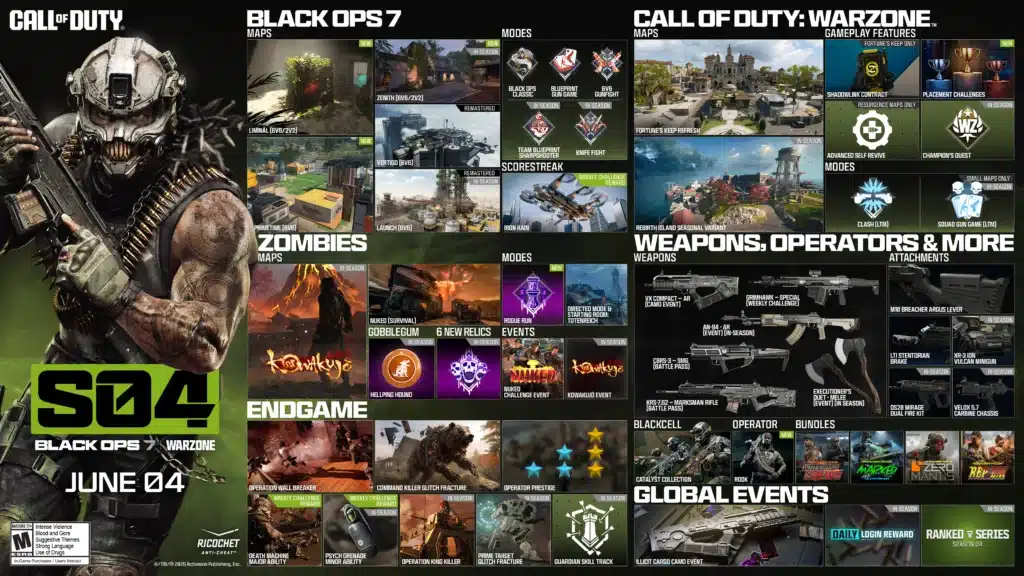
Activision’s machine is relentless. Black Ops 7‘s fourth season alone advertised five new or remastered multiplayer maps, modes, weapons, Zombies additions, events and a refreshed Warzone location. Halo does not need that exact volume, but it desperately needs the habit: tell players what is coming, ship it on time and make the next drop visible before the current one goes stale.
3. Campaign and multiplayer could stop fighting for the same oxygen
Halo fans should never have to choose between a proper campaign and a healthy multiplayer game. Activision routinely splits those responsibilities: Raven led the Black Ops 6 campaign while Treyarch led the wider game. The result was room for a bespoke spy thriller alongside multiplayer, Zombies and Warzone.
Microsoft could apply the same logic without turning Master Chief into Captain Price. Halo Studios should own the creative direction; an Activision campaign team or support studio could help it execute. The upcoming Halo: Campaign Evolved already promises split-screen, four-player online co-op, new missions and cross-platform progression. A deeper production bench would give ambitious checklists like that a better chance of being present on day one.
4. The boring technical work is exactly where Activision is strongest
No one puts “stable matchmaking backend” on a collector’s-edition statue, but it matters more than another shiny trailer. Activision owns Demonware, whose technology has supported matchmaking, player profiles and statistics across Call of Duty for years. Beenox has specialised in PC development, while central technology and QA teams support releases across several platforms.
That experience maps neatly onto the next era of Halo. Campaign Evolved is coming to Xbox, PC and PlayStation 5, so cross-play, shared progression, input balance and anti-cheat are no longer side quests. Our coverage of Xbox spreading beyond the console box shows how many endpoints Microsoft now wants to serve. Activision has spent years learning how to make a giant shooter function across that mess.
5. Activision can make Halo feel like an event again
Halo still has one of gaming’s most recognisable helmets, but recognition is not momentum. Activision coordinates worldwide reveals, betas, creator events, seasonal beats and platform-wide launches with frightening efficiency. We saw the appetite building before Black Ops 6‘s much-anticipated beta, and Microsoft later called it the biggest Call of Duty release ever, with record day-one players and Game Pass subscriber additions.
That reach could help Halo step out of the old “Xbox mascot” box just as Campaign Evolved reaches PlayStation. Microsoft and Activision already sit in the same corporate house, a relationship we examined when arguing the Activision deal could benefit players. Using that marketing apparatus for Master Chief would be obvious corporate gardening: water the icon you already own.
The strongest argument against it is also the rule Microsoft must set
Activision’s greatest strength can become its ugliest habit. Annual deadlines, aggressive stores and a hunger for engagement can flatten a distinctive game into content mulch. Call of Duty: Modern Warfare III landed at just 56 on Metacritic, and the mixed response to Black Ops 7 pushed Activision to promise it would stop releasing back-to-back games from the same sub-series. Faster is not automatically better.
That is why the good version of this idea is not “paint Call of Duty green.” Halo Studios keeps creative control, protects the slower combat rhythm, strange sci-fi melancholy, Forge and campaign co-op, while Activision supplies production discipline, specialist teams and a reliable live calendar. If Microsoft confuses stewardship with homogenisation, fans should reject it. If it uses Activision to help Halo Studios finish what it imagines, though, the Chief might finally get both the game and the follow-through he deserves.
About the author


The conversation
Comments are closed.